
Alumina Technology Sustainability Framework
The alumina industry produces around 130 million tonnes of alumina each year, 90% of which is used in aluminium production. Smaller amounts are essential for the manufacture of ceramics, refractories, glass, plastics and abrasives.
Aluminium is key to modern life, in buildings, transport and packaging, and in communication and power distribution networks. It is highly recyclable, but growing demand will require increasing new metal production from alumina to 2050 and beyond.
The alumina industry strives for responsible, sustainable production of quality product while minimising negative effects to communities and the environment.
This Roadmap is a framework for the alumina industry to use its expertise and innovation to minimise harm and maximise benefits in its operations and across related value chains.
The Alumina Industry
Link to the International Aluminium Institute’s website for an overview of the alumina industry. The process from bauxite mining to purified alumina ready for smelting to aluminium is described on the Refining page and in more detail in Bauxite to Alumina: The Bayer Process.
Mission
The Mission of the Alumina Industry is for all new refineries by 2050 to
- be GHG- and fresh water-neutral
- emit negligible volatile organic carbons (VOCs) and mercury to air
- have no visible emissions to air
- have zero long-term bauxite residue storage.
2050 Goals
- Global average energy consumption reduced by 2 GJ/tA from 2020 base
- Global alumina production 100% carbon neutral
- Zero new long-term bauxite residue storage
- Zero leakage or structural failures of legacy residue storage impoundments
- Zero net fresh water import
- Meet or exceed all applicable environmental, health and safety standards in relation to emissions to soil, water and air, including net zero CO2e to air
The Alumina/Aluminium Value Chain
The Alumina Technology Roadmap is focused on the alumina refinery, and excludes both bauxite mining and alumina transport. (Image courtesy IAI).
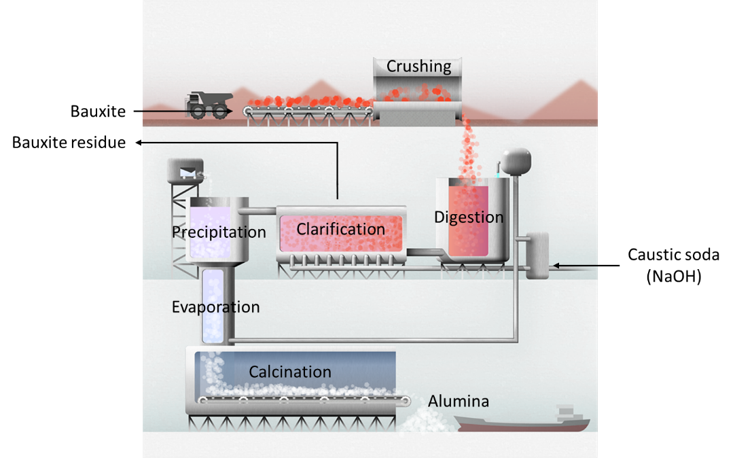
Boundaries:ATR 2050 relates to the alumina refining process itself, from bauxite delivery to product loading, i.e.: |
||
Excluding:INPUTS |
Including:PRODUCTION, WASTES & EMISSIONS |
Excluding:PRODUCT OUTPUT |
|
• Bauxite mining, delivery and rehabilitation • Production and delivery of: • caustic soda • lime • process chemicals • fuel • water |
Production unit operations, including: • bauxite milling • desilication • digestion • evaporation • mud settling and washing • precipitation • heat exchange • impurity removal • calcination • alumina storage and loading |
• alumina transport • smelting to aluminium |
|
Wastes and emissions: • bauxite residue • emissions to air (GHGs, VOCs, Hg) • process steam |
||
Alumina Production Sustainability: Progress and Challenges
Bayer Process Chemistry
Thermodynamic models of industrial processes are very useful in providing real increases in process productivity and efficiency. The predictive capability of such models depends significantly on the accuracy of their underlying data. In this context, accurate experimental measurements of liquor properties are essential. Collaborative research work has resulted in substantial improvements in process simulators at realistic temperatures and liquor concentrations found in the Bayer process. This work has led to significant increases in refinery productivity and efficiency.
Alumina Product Quality
Detailed collaborative studies of the formation of aluminium hydroxide or ‘hydrate’ particles in the Bayer precipitation circuit have enhanced understanding of how the agglomerates form and how their toughness may be improved. Subsequent calcination of hydrates has directed understanding of what happens in calciners, especially the unwanted formation of fine particles as coarser ones fracture. This has led to process changes to ensure production of tougher hydrates and less breakdown, producing alumina with superior properties for supply to aluminium smelters.
Other collaborative studies have examined the mechanisms of alumina particle breakdown in aluminium smelters and how process changes can reduce the impacts of fine alumina on smelter efficiency and environmental considerations.
Bayer Process Efficiency
Reduced scale formation
The formation of scale on the walls of tanks and pipework impacts on refinery productivity, and any reduction in the maintenance required to remove scale increases efficiency. With industry awareness of the problems scale can cause, and this topic having been highlighted in a previous edition of the Technology Roadmap, a specialty chemical company was able to develop an additive to the liquor which significantly reduces scale formation without any deleterious effects on liquor productivity.
Improved thickener operation
Thickeners in alumina refineries separate the residue (red mud) from the pregnant Bayer liquor (rich in dissolved alumina). Substantial collaborative research has been conducted on the operation of thickeners, in particular to:
- maximise the efficient use of flocculants added to enhance thickening
- maximise their throughput by utilising computational fluid dynamics (CFD) to determine the most effective design of rakes and overflow weirs.
Results have led to dramatic improvements in thickener operation.
Bayer Residue Management
Understanding sustainability of bauxite residue storage
The first Alumina Technology Roadmap identified a goal for bauxite residue:
“Develop methods to achieve a 1,000-year ecologically sustainable storage of red mud and other solid wastes in existing storages, and make substantial progress in storage for later reuse as well as achieve substantial progress in the reuse of the red mud.”
A subsequent collaborative project entitled Bauxite Residue Sustainability Measure of Improvement addressed the need for quantitative measures for the assessment of storage practices, using a quantitative, risk-based methodology within a sustainability framework. It delivered:
- a risk-based methodology for the evaluation of current and proposed residue storage practices in a sustainability framework
- a basis for business cases for change where desirable, and a direction for technology development
- benchmarking of practices in other industries
- proposals for best practices on a flexible, situational basis
- improved understanding of the balance between costs and risks of current and future options, including whole of life costs
- inputs to the development of legislation and in responding to community concerns.
Managing naturally occurring radioactivity in context
Bauxite can contain naturally occurring radioactivity from the presence of U-238 and/or Th-232. Some of the radioactivity is associated with minerals such as ilmenite, monazite or zircon in the bauxite. Most of the radioactivity present in the ore is transferred to the residue tailings (red mud) from the Bayer caustic leaching process. There is an increasing need to understand the nature of the radioactivity contained in ores, process intermediates and wastes as the result of changing international guidelines, Codes of Practice and regulations relating to the presence of naturally occurring radioactive material (NORM). Strategic research is required to better characterise the occurrence and distribution of NORM in bauxite ores and residues in order to facilitate the future management of residues and the possible use of the residues in other industries.
A collaborative project was undertaken to deliver:
- A report on the available data on radioactivity and measured doses associated with bauxite ores and leach residues and solutions deposited in red mud tailings facilities. It examined the range of data in the alumina industry and placed it into context with respect to NORM concentrations and associated doses.
- A report on international and local regulations and trends, and the implications for bauxite mining and alumina producers. It interpreted the current regulatory position and the trends in international guidelines and regulations in the context of the broader minerals industry, which might be seen as affected by the presence of NORM, and the radioactivity concentration and dose data for the range of specific circumstances existing in the Australian alumina industry.
Ecotoxicity of bauxite residue trace elements
Bauxites and associated leachate contain a range of trace elements. These trace elements may be associated with the residue slurries, or leached from the residue deposits over time and need to be managed accordingly.
A collaborative project identified and collated best practice testing protocols for a range of bauxite residue trace elements in terms of their ecotoxicity. Of particular importance was an understanding of ecotoxicity with respect to:
- open circuit discharge
- long-term management of closed residue deposits where leachate will need to be collected, treated and possibly discharged
- re-use of residue where trace elements have the potential to leach into receiving environments.
The project achieved a good understanding of the way ecotoxicity might be assessed and how this assessment can be structured into guidelines/regulatory frameworks for managing water quality. The study reviewed existing testing protocols and identified those likely to be considered best practice for bauxite residue type leachate and the specific receiving environments of interest.
Constructed wetlands to treat alkaline leachate
A collaborative project was conducted at the Aughinish alumina refinery to study constructed wetlands for treatment of alkaline leachate from bauxite residue disposal areas.
Bauxite Residue as a Resource
- Selection of a standardised leach testing protocol for development of a risk-based by-product assessment methodology.
- Utilisation of bauxite residue in the production and use of geopolymers.
- The International Aluminium Institute commissioned a series of detailed reviews on the use of bauxite residue (BR) in the cement industry. These cover existing and potential use in:
- Portland Cement clinker production
- special cements
- supplementary cementitious materials.
To assist in expanding use of residue in these areas, an Excel-based calculation tool was developed to provide a simple assessment of the possible applications of BR in the cement production chain. The main objective of this tool is to present a robust evaluation of an alternative use of BR, respecting the requirements of each industrial sector. The tool is designed to be used by representatives of both the bauxite residue producers and cement sectors from a number of participating countries.
The specific objective of the tool is to provide a comparative analysis of a baseline operation from the cement industry with alternative scenarios including the addition of bauxite residue in its normal operation, as well as an economic analysis for the bauxite residue producer over the possible disposal of its residue.
The tool evaluates electricity use, fuel consumption, expected emissions and related costs per tonne of material produced, comparing all possible scenarios of addition of bauxite residue with the baseline of normal operation of the cement plant. In addition, the tool assesses the logistical expenses and potential cost avoidances and revenues that are possible for the bauxite residue producer with commercialisation.
ATR 2050 and the SDGs
In 2015, the United Nations established a set of goals to end poverty, protect the planet, and ensure prosperity for all. Each of these 17 Sustainable Development Goals (SDGs) includes specific targets to be achieved by 2030. Achieving the SDGs requires the efforts of governments, the private sector, civil society, communities and individuals.
We have identified the following nine SDGs as applicable to the alumina industry. As a technology-intensive industry, we recognise that technology development is key to step-change improvements in sustainability performance. ATR 2050 articulates key improvement goals and shows how they contribute to specific SDGs.
3. Good Health and Wellbeing

Applicable Global Goals:
- To substantially reduce the number of deaths and illnesses from hazardous chemicals and air, water and soil pollution and contamination
Industry Contributions:
The alumina industry is a world leader in industrial safety and is strongly committed to the health and wellbeing of its employees, contractors and community members. Technology innovation and development contributes substantially in the areas of personal safety (e.g. implementation of Diphoterine for burns management, elimination of heavy manual tasks by improved process design, automation and robotics), health (e.g. reduction of emissions to air, comprehensive health monitoring and support for all personnel) and environmental management (e.g. global benchmark rehabilitation of mined areas, major improvements in residue management and rehabilitation, commitment to long-term elimination of bauxite residue).
6. Clean Water and Sanitation
Applicable Global Goals:
- Improve water quality by reducing pollution, eliminating dumping and minimising release of hazardous chemicals and materials, halving the proportion of untreated wastewater and substantially increasing recycling and safe reuse globally
- Substantially increase water-use efficiency and ensure sustainable withdrawals and supply of freshwater to address water scarcity and substantially reduce the number of people suffering from water scarcity
- Protect and restore water-related ecosystems, including mountains, forests, wetlands, rivers, aquifers and lakes
Industry Contributions:
Water management is a key focus area of the alumina industry. The industry is committed to minimising freshwater use, preserving freshwater resources and ecosystems, and minimising pollution of terrestrial and sea waters. Technology innovation and development in this area has included major improvements in evaporation efficiency and water conservation; future targets include recovery of water from process steam, e.g. from hydrate calcination.
7. Affordable and Clean Energy
Applicable Global Goals:
- Increase substantially the share of renewable energy in the global energy mix
- Double the global rate of improvement in energy efficiency
Industry Contributions:
Renewable energy is an exciting new area for the industry. There are immediate opportunities to introduce renewable electricity, the major challenge will be to find practical, economic ways to generate heat for the critical processes of bauxite digestion and hydrate calcination. These challenges will require collaboration beyond the industry to other industries, and the support of private and public research institutes.
8. Decent Work and Economic Growth

Applicable Global Goals:
- Progressively improve global resource efficiency in consumption and production and endeavour to decouple economic growth from environmental degradation
Industry Contributions:
The alumina industry is committed to continuous improvement of cost of production and reduction of environmental impact. Progress has been underpinned by technology innovation and improvement through the history of the industry, and will continue to be a key area of progress into the future. Companies operating refineries and mining bauxite in developing countries take on leadership roles in all aspects of the business in which they operate.
9. Industry, Innovation and Infrastructure

Applicable Global Goals:
- Upgrade infrastructure and retrofit industries to make them sustainable, with increased resource-use efficiency and greater adoption of clean and environmentally sound technologies and industrial processes
- Enhance scientific research, upgrade the technological capabilities of industrial sectors in all countries, in particular developing countries, including encouraging innovation and substantially increasing the number of research and development workers per 1 million people and public and private research and development spending
Industry Contributions:
The alumina industry is committed to continuous improvement in its existing facilities, and to step-change improvements in new installations and major expansions. Introduction of clean energy and zero residue are examples of technology-driven initiatives. Scientific research and technology development are key in this technology-rich industry. The industry has a proud history of support for collaborative research and the implementation of new technology in all the countries in which it operates.
12. Responsible Consumption and Production
Applicable Global Goals:
- Achieve the sustainable management and efficient use of natural resources
- Achieve the environmentally sound management of chemicals and all wastes throughout their life cycle, in accordance with agreed international frameworks, and significantly reduce their release to air, water and soil in order to minimise their adverse impacts on human health and the environment
- Substantially reduce waste generation through prevention, reduction, recycling and re-use
Industry Contributions:
The alumina industry has a proud record of responsible management of chemicals and wastes and is committed to continuous improvement in these areas. Elimination of bauxite residue, our biggest waste, is a key 2050 goal. Major reductions in emissions of volatile organic compounds (VOCs) and mercury to air have been made, and further improvement is targeted. Continuous reduction in raw materials consumption rates – bauxite, caustic soda, water, process chemicals and energy – is embedded in our operating culture.
13. Climate Action

Applicable Global Goals:
- Integrate climate change measures into national policies, strategies and planning
Industry Contributions:
The alumina industry’s main influence on climate is through its GHG emissions, which are primarily related to energy use. Our contribution to this SDG is therefore via our commitment to SDG 7, ‘Affordable and Clean Energy’, and the ultimate vision of decarbonisation of our energy sources.
15. Life on Land

Applicable Global Goals:
- Ensure the conservation, restoration and sustainable use of terrestrial and inland freshwater ecosystems and their services, in particular forests, wetlands, mountains and drylands, in line with obligations under international agreements
- Promote the implementation of sustainable management of all types of forests, halt deforestation, restore degraded forests and substantially increase afforestation and reforestation globally
- Take urgent and significant action to reduce the degradation of natural habitats, halt the loss of biodiversity and protect and prevent the extinction of threatened species
Industry Contributions:
The alumina industry has a record of success in the restoration of ecosystems after rehabilitating bauxite residue storage areas. We are committed to maintaining global leadership in this area.
17. Partnerships for the Goals

Applicable Global Goals:
- Encourage and promote effective public, public-private and civil society partnerships, building on the experience and resourcing strategies of partnerships
Industry Contributions:
The alumina industry has established structures to promote pre-competitive research and technology development across the industry and with its suppliers and collaborators. Through this Roadmap these efforts will be focussed on achieving the 2050 SDGs.
4 Comments
Submit a Comment
You must be logged in to post a comment.
As for a bauxite residue remediation, I have a question about the progress of ‘in situ remediation of bauxite residue’ by Talitha C. Santin. IAI must have a project to support it, but I can not find any progress of it in this section.
NORM issue: I do not know well about the behavior of NORM elements in the Bayer process. When it comes to contamination of U and Th in the product alumina, they precipitate at the early stage of precipitation step from the pregnant liquor saturated by these elements (Alcoa’s patent and or study). If they are removed in the Bayer liquor efficiently, it may help to reduce contamination of bauxite residue by U & Th. Study of the behavior of these elements will contribute to reduce the NORM in bauxite residue.
Under the title of this page, some applications of alumina are shown. Here, just alumina are shown. I think aluminum hydrate (gibbsite) before calcination is very important for aluminum chemicals.
SDGs 3: Good health and wellbeing. I completely agree to the applicable Global Goal. I think that the alumina industry will employ more advanced and sophisticated control system with AI in near future. But the factory itself must be still in dangerous conditions of high alkaline, high temperature, red and white streams, therefore, training of operators is a very important for the industry not only AI issue but also fundamentals and risks of Bayer process, chemicals and plant materials, especially to meet troubles in case. In some area it is not easy to keep good operators there.