
ATR 2050:
- Shows the way to carbon-neutral, sustainable alumina production by 2050 through technological innovation
- A natural evolution from previous Alumina Technology Roadmaps
- Encourages collaboration between producers, suppliers, customers, universities and other public and private research institutions
- Focuses on the Bayer process, but is open to alternative technologies

ATR 2050 has been developed with consideration of the SDG Sector Roadmap Guidelines (2018) of the World Business Council for Sustainable Development (WBSCD).
Priority areas for action are:
- carbon-neutral alumina production to support the broader aluminium industry greenhouse reduction goal
- sustainable bauxite residue management towards a goal of zero storage
- emissions reduction (in addition to GHGs) towards a goal of zero emissions to air, water and land
- fresh water use towards a goal of zero import from high-quality water sources
Method and Approach
The first Alumina Technology Roadmap provided the framework for focused research in the areas most critical to the industry. Created in 2001 and updated in 2006 and 2010, the Roadmap stimulated highly productive research programs on precipitation, calcination, thickening, air emissions and residue management.
As we approach the 20-year horizon set in 2001, much has been achieved but there is still much to be done. An ongoing research program, responsive to changing stakeholder expectations and able to leverage emerging technology developments, is essential for our long-term industry aspirations.
The refocus to 2050 began in 2017 with a framework based on Themes and Impact Opportunities developed by the Alumina Technical Panel, the technical advisory group to the Bauxite Alumina Committee of the IAI. This was further developed at the ATR workshop at Alumina 2018 in Gladstone, Australia. With broad representation and contribution from the industry, suppliers and collaborators, ATR 2050 was endorsed as a living guide to the technology direction of the alumina industry to a sustainable 2050.
Date |
Intent |
Activity |
October1996 |
Develop a vision for the future and a roadmap to achieve it. Specific focus to increase energy efficiency and reduce wastes in the production of aluminium | US Dept. Energy and Aluminium Association signed an ‘Industry of the Future’ agreement for industry led, Government supported pre-competitive research and development |
May2001 |
Enhance the long-term competitiveness of the alumina industry by establishing strategic goals for 2020 | First Alumina Technology Roadmap developed by a steering committee as a framework for a long-term research and development plan to address the strategic goals |
2005 |
Broad industry membership with links to the board of the IAI | International Aluminium Institute (IAI) established a Bauxite and Alumina Committee (BAC) and sponsored Roadmap |
2005 |
Clearer path forward for promoting and implementing collaborative research and technology developments | Alumina Technical Panel (ATP) reconvened, comprised of R&D managers from 5+ of the major alumina producers, to advise, project manage, and contribute technically to the BAC. |
2006 |
Refresh the vision | Minor Roadmap update |
April 2010 |
Extend the Roadmap to include the Chinese alumina community given the significant production increases and the unique bauxites in China | Updated Roadmap with collaboration with 21 of the 34 Chinese alumina refineries |
September2018 |
Envisage the ideal future and how to get there in targeted themes of: Energy, Residue, Process & Technology, Industry 4.0 Digital, and Market Risks and Responses | ATR Workshop with 100 delegates towards new Roadmap encompassing 2050 goals |
Road to 2050
The purpose of the Roadmap is to guide producers, suppliers and research providers in developing pre-competitive research programs aligned to SDG goals and alumina industry priorities.
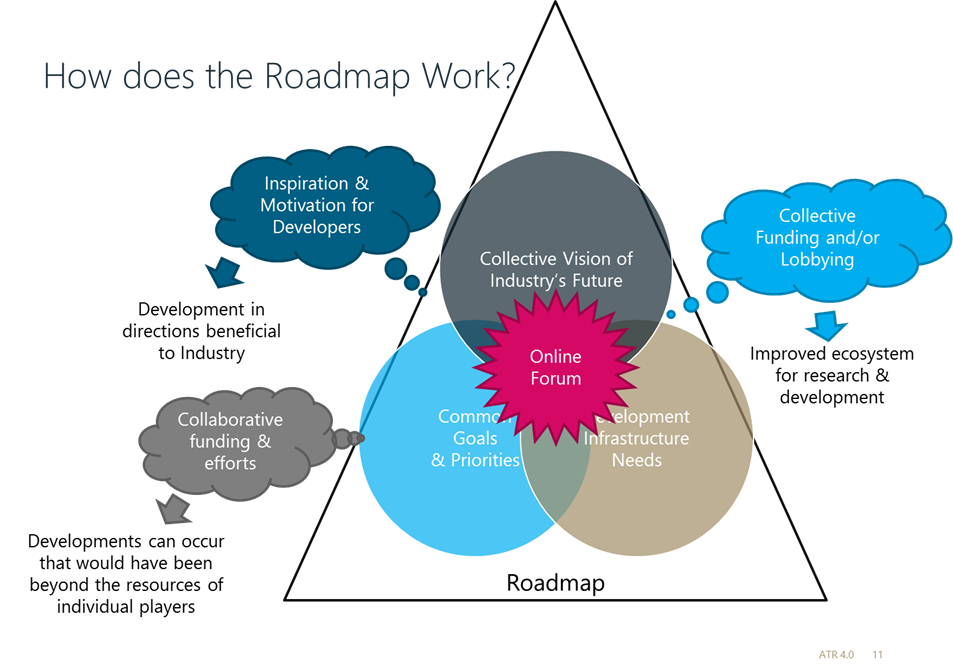
At its core, the Roadmap holds:
- the collective vision of the industry’s future
- an agreed set of common goals and priorities
- a list of development infrastructure needs
- an on-line forum for discussion.
The Roadmap aims to inspire and motivate technology developers to leverage funding and collaborative efforts for benefits beyond the resources of individuals:
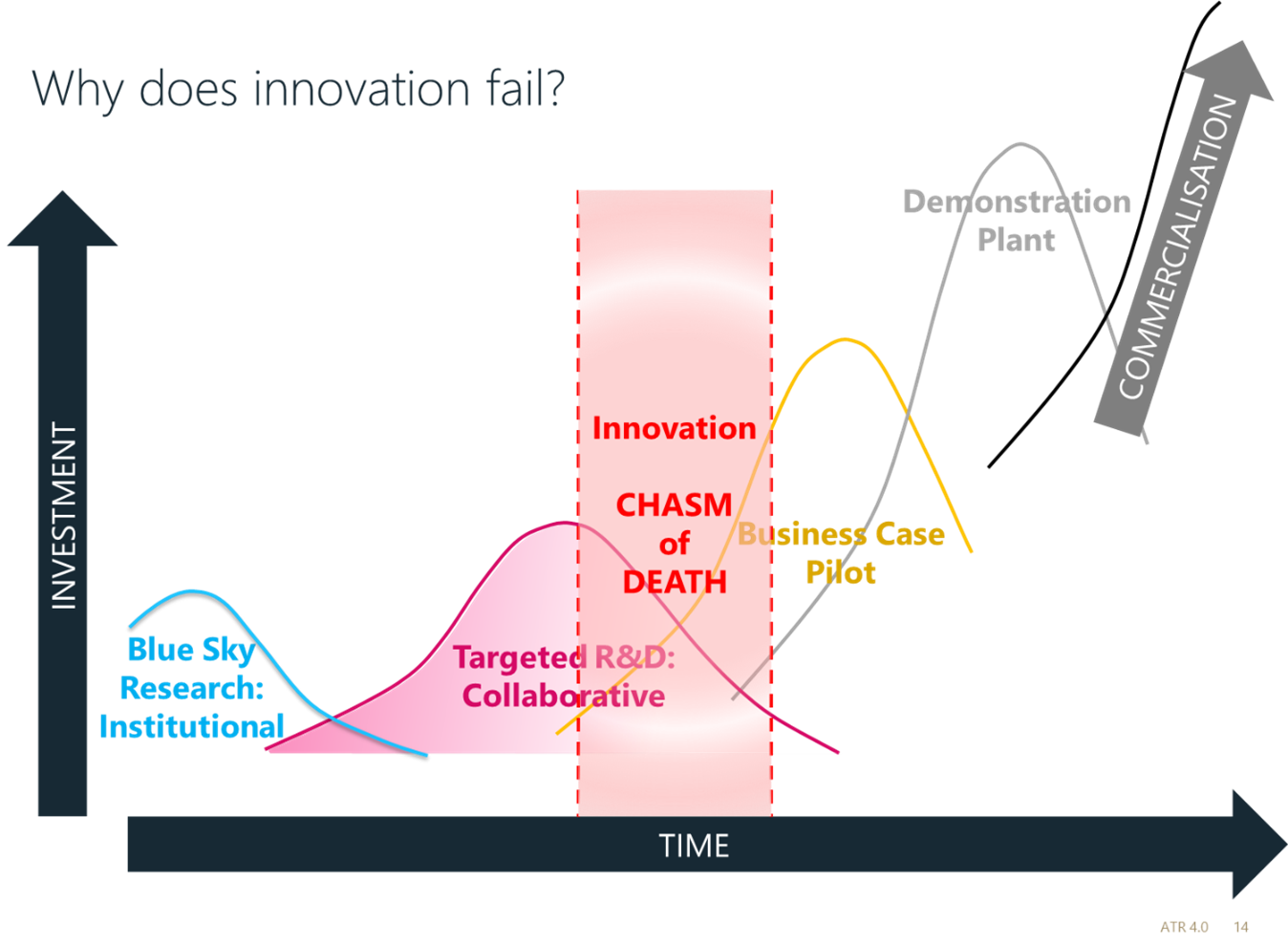
Through this process the Roadmap aims to improve the targeting and funding of research to maximise the rate of implementation of innovations, by helping bridge the ‘Innovation Chasm of Death’ to allow research to developments to come to fruition as beneficial new technologies (diagram adapted from CRC Ore).
ATR 2050 Themes and Impact Opportunities
The areas where the alumina industry can contribute to global Sustainability have been classified according to five Themes: Energy, Residue, Water, Emissions and Alternative Production. Aspects that have the potential for transformative innovation are identified as Impact Opportunities within these Themes. For details click here: ‘Themes & IOs‘.
Focus on Sustainable Development
The Alumina Technical Panel sees alignment with the World Business Council Sustainable Development Goals (SDGs) as important to the success of ATR 2050, which relies on collaboration across the industry, not only between alumina producers but also with suppliers (of materials, services and technology), customers, governments, research institutions and the communities within which they operate.
The SDGs applicable to this Technology Roadmap are:

2 Comments
Submit a Comment
You must be logged in to post a comment.
I think that the SDGs’ Goal 14 ‘LIFE BELOW WATER’ should be added to our sustainable development. Because some refineries use plenty of seawater for neutralization of bauxite residue and return (discharge) the liquor to sea. The liquor will contain BOD/COD, SS and some materials.
Therefore, a word ‘seawater’ also should be added in the priority statement of towards a goal of zero emissions
The ATR 2050 is a highly welcome initiative, because the Bayer Process offers so many promising process steps with a very, very high potential for sustainability. As a process engineer with some experience and spent time in alumina refineries I have to admit in the first moment, that old wine is bottled in new wineskins but now the label shows the year 2050.
But coming back to more serious arguments. In the last 20 years we have seen remarkable undertakings to innovate the Bayer process. I remember to the „high pressure digestion process“ where Alcan and others played a remarkable role. The Chinese alumina refineries looked for long time how to improve the yield when digesting the typical Chinese bauxite in the sinter process. The avoidance of a loss of about 5% in alumina by recrystallisation of the already dissolved alumina is a major challenge. The ILTD process of some Hungarian engineers needs encouragement to install this innovative process step by step. And finally the very fine grained, freshly digested, hot, pressurized bauxite slurry can be separated and even washed out before decompression of the slurry. At the end it will lead to a process and plant design which will not only lead to an unbelievable saving in CAPEX but especially in OPEX and finally in an enormous increase of the so liked sustainability. Our former engineer colleagues in the middle of the last century already did show how to go this way. But at that time other understandings of feasibility and process design have been very much different. Nevertheless this old guys did show remarkable process features and promising results for the so-called “direct filtration”.
But to get all this benefits of the sustainability it needs encouragement of the decision makers, it needs thinking out of the box and it needs a kind of blackmailing the top management by the green policy and new profit definitions.
Thus, if you think that this encouragement and thinking out of the box is now part of ATR2050 I am willingly prepared to join your group and to contribute my expertise.